
Newsroom


A team of researchers led by the Nanjing Institute of Geology and Palaeontology of the Chinese Academy of Sciences (NIGPAS), in collaboration with colleagues from Shanghai Jiao Tong University, the University of Bristol, and Nanjing University, has identified the primary non-environmental factors controlling Lithium-to-Magnesium ratio (Li/Mg) fractionation. Their findings were recently published in Earth and Planetary Science Letters.
Deep-sea scleractinian corals function as critical "natural archives," preserving high-resolution geochemical records of long-term oceanographic changes. Among emerging proxies for past ocean conditions, the Li/Mg ratio in coral skeletons has gained attention as a potential paleothermometer. However, its reliability has been compromised by unexplained variability across different skeletal structures and an incomplete understanding of the underlying biomineralization mechanisms.
To isolate the drivers of this geochemical variability, the research team conducted a systematic analysis of 60 modern branching cold-water coral specimens. These specimens were collected from the North Atlantic, Equatorial Atlantic, and Eastern Equatorial Pacific.
The researchers performed comparative sampling of two distinct skeletal components: the corallites (cup skeletons) and the branches (coenosteum). Their results revealed a significant and systematic offset: trace element ratios, including Li/Ca, Mg/Ca, B/Ca, and most notably Li/Mg, were consistently enriched in corallites compared to the branches. In contrast, Sr/Ca and U/Ca ratios exhibited the opposite pattern.
After accounting for and excluding the influence of Centers of Calcification (COC), the team's modeling results, combined with data from existing inorganic precipitation experiments, identified skeletal growth rate as the dominant factor controlling the Li/Mg offset between the corallites and the branches.
Based on these findings, the researchers advocate for the adoption of a standardized sampling protocol that strictly differentiates between the two skeletal structures— specifically separating corallites from the branches. This step is critical to eliminating systematic errors caused by variations in growth rate. Furthermore, the study emphasizes the necessity of integrating biomineralization mechanisms into future Li/Mg temperature calibration models to minimize proxy uncertainty.
This work was supported by the National Key Research and Development Program of China and the National Natural Science Foundation of China.
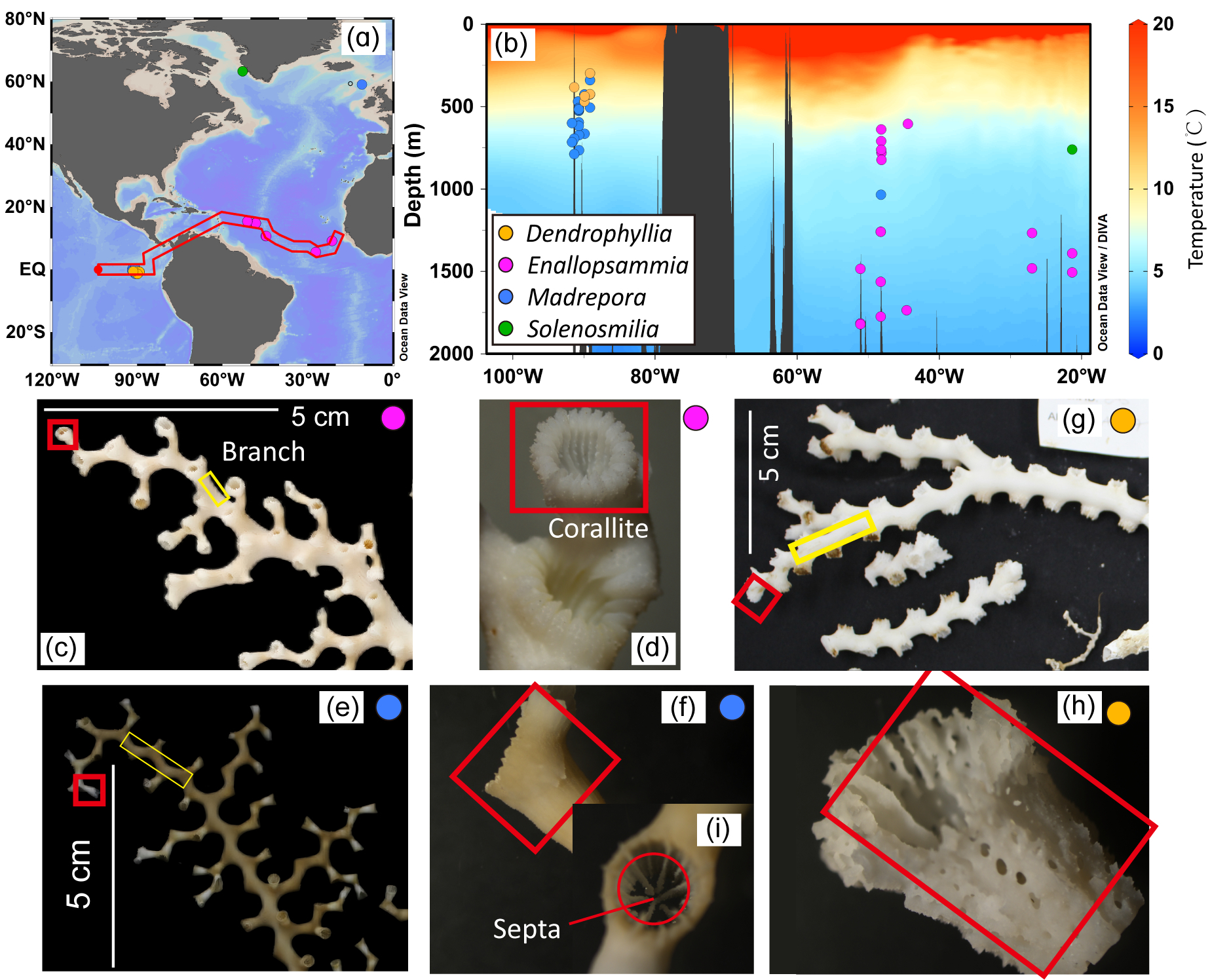
Colonial cold-water coral collection map and the subsampling strategy. (Image by NIGPAS)
